

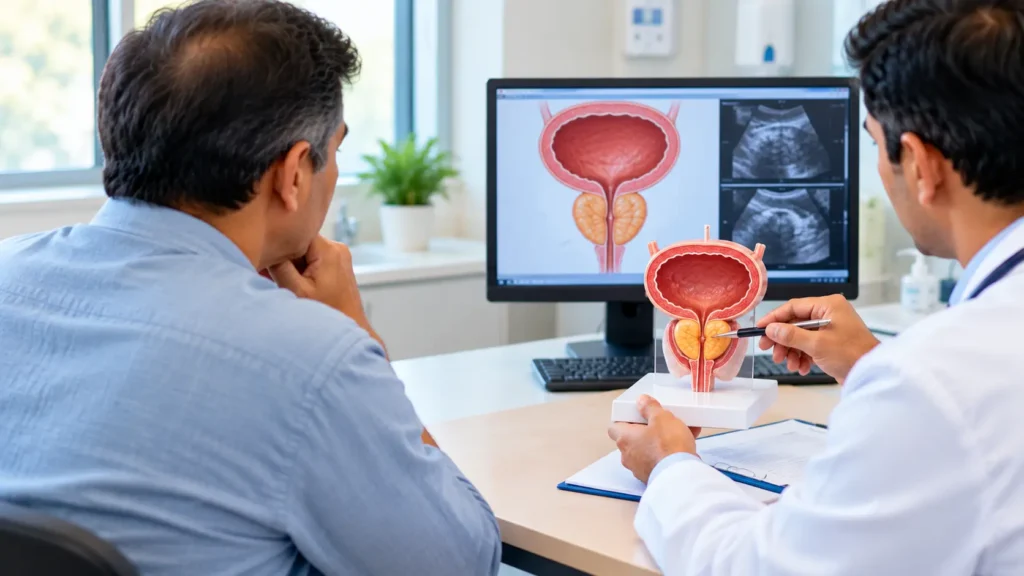
Waking up twice a night to pass urine is easy to brush off as just another part of getting older. But when you add in a weak stream, a constant feeling that your bladder never quite empties, and a few frustrating drops that follow you from the toilet, the pattern points directly toward the prostate. When men visit our hospital for prostate treatment in Rewa, they are often relieved to learn that an enlarged prostate does not automatically mean they need surgery. Sometimes, the same symptoms can even be caused by entirely different, easily treatable conditions. Urinary trouble is incredibly common in older men, but it is always worth checking rather than ignoring. A proper clinical diagnosis will tell us whether you need simple lifestyle changes, medication, a minor procedure, or just regular observation.
Enlarged Prostate Symptoms: Frequent Urination and Weak Stream
Benign prostatic enlargement is a noncancerous increase in the size of the prostate, the walnut sized gland that surrounds the urethra below the bladder. As it grows, it can narrow the urine passage, causing frequent urination, a weak stream and incomplete emptying. It becomes more common with age.
- Frequent urination often comes with a sudden urge that is incredibly hard to delay.
- A weak urine stream that is slow, splitting, or constantly stopping and starting.
- Nighttime urination that wakes you two or more times and spoils sleep.
- Hesitancy, which means waiting before the stream begins, and straining to pass urine.
- Dribbling after urination and a feeling that the bladder has not emptied fully.
- Repeated urine infections, or blood in the urine, which need prompt assessment.
Urinary symptoms in older men are too often blamed on aging alone. The NHS enlarged prostate page says the main symptoms are problems with peeing, and it stresses that these symptoms should be checked because they can sometimes be caused by other, more serious conditions, such as prostate cancer.
Why an Enlarged Prostate Disturbs the Urine Flow
The urethra runs through the middle of the prostate, so growth of the gland can squeeze the passage and make the bladder work harder. The bladder wall thickens, becomes irritable and may not empty fully. In our clinical experience, these symptoms tend to worsen gradually. Interestingly, the physical size of the prostate does not always match the severity of the symptoms.
Urinary Retention and Other Emergencies
Being unable to pass urine at all, severe lower belly pain, fever with urinary symptoms, or blood clots in the urine needs emergency care at once. A completely blocked bladder is called acute urinary retention, and it needs prompt relief with a catheter.
- Not passing urine for several hours despite a full, painful bladder.
- Fever, shivering or burning urine with pain in the lower belly or back.
- Passing blood or clots in the urine.
- Sudden confusion or severe weakness in an older man with urinary symptoms.
Other Causes of Urinary Symptoms: Why Evaluation Comes Before Treatment
Several conditions mimic an enlarged prostate, so treating the symptoms without identifying the cause can miss the real problem. The table shows common patterns, not a diagnosis.
| Cause | Clues | Why it matters |
|---|---|---|
| Benign prostatic enlargement | Slow stream, hesitancy, night waking, incomplete emptying | Treated by lifestyle changes, medicines or a procedure, depending on the symptoms |
| Urine infection or prostate inflammation | Burning, urgency, fever, pain in the pelvis or perineum | Needs a urine test and antibiotics |
| Bladder stones | Interrupted stream, pain, blood in urine | Often linked to incomplete bladder emptying |
| Narrowing of the urethra | A thin, forked stream, often after infection or injury | Needs a different treatment from prostate surgery |
| Overactive bladder | Urgency and frequency with little blockage | Treated with different medicines and bladder training |
| Diabetes or some medicines | Passing large amounts of urine, or symptoms after starting a medicine | Certain medicines can cause side effects that mimic prostate issues. |
| Prostate cancer | Often no early symptoms, or symptoms that resemble BPH | Needs separate tests, which is why evaluation matters |
Prostate Evaluation: Tests That Guide Your Diagnosis
A prostate consultation begins with your story, and a prostate specialist in Rewa, usually a urologist or a surgeon with experience in urinary conditions, will combine an examination with simple tests. We typically guide patients through the following diagnostic steps:
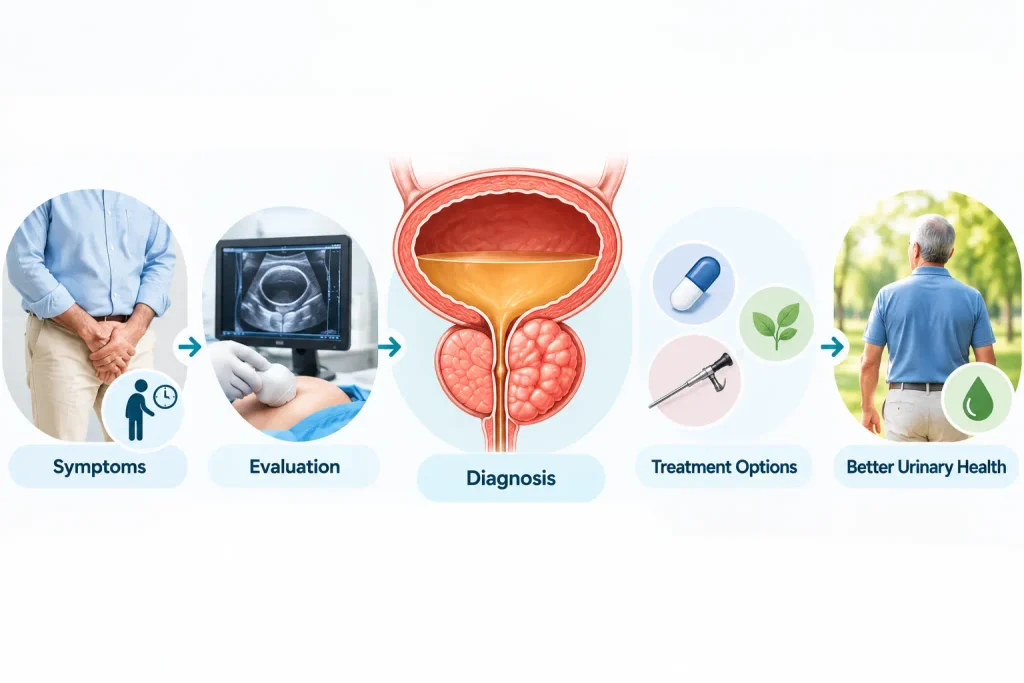
- History and symptom score: how often you pass urine, the strength of the stream, night waking and how much the symptoms bother you, often using a standard questionnaire.
- Medicine review: some medicines, including certain cold remedies and water tablets, can worsen urinary symptoms.
- Examination: the lower belly and genitals are examined, and a digital rectal examination allows the doctor to feel the size and surface of the prostate.
- Urine test: to look for infection, blood or sugar.
- Blood tests: kidney function, and, after counselling about what the result means, a prostate specific antigen test.
- Urinary flow assessment: a simple test in which you pass urine into a device that measures the flow, often with a bladder scan to see how much urine remains afterwards.
- Further tests when needed: an ultrasound of the kidneys, bladder and prostate, a camera check of the urethra and bladder, or pressure studies of the bladder.
This careful prostate diagnosis matters because treatment for an enlarged prostate is chosen by symptoms and test results, and the same tests help to rule out other conditions.
When Treatment Is Needed: Benign Prostatic Enlargement and Reasonable Watching
An enlarged prostate does not always need treatment right away. If your symptoms are mild and tolerable, we may decide to safely postpone treatment and simply monitor your condition.
- Moderate or severe symptoms that disturb sleep, work or travel.
- Medicines that have not relieved the symptoms or cause side effects that you cannot accept.
- Urinary retention, meaning being unable to empty the bladder.
- Repeated urine infections, bladder stones or blood in the urine linked to the prostate.
- Signs that the kidneys are under pressure from a bladder that cannot empty.
Self Care and Lifestyle Steps
- Keep to a healthy weight, as the NHS notes that being overweight can make symptoms worse.
- Cut back on caffeine and fizzy drinks, which irritate the bladder.
- Limit drinks in the evening, and empty the bladder before bed.
- Pass urine at regular times, and take time to empty fully.
- Stay active, because exercise may lower the risk of prostate enlargement, according to the Mayo Clinic.
Medicines for an Enlarged Prostate
| Type of medicine | How it helps | Points to discuss |
|---|---|---|
| Alpha blockers, such as tamsulosin, doxazosin or alfuzosin | Relax the muscle at the bladder outlet so that urine flows more easily | Dizziness on standing, and changes in ejaculation in some men |
| Five alpha reductase inhibitors, such as finasteride or dutasteride | Shrink the prostate slowly over months by lowering hormone levels | Used for larger prostates, and may affect sexual function in some men |
| Combination treatment | Uses both types together | Suited to larger prostates or more troublesome symptoms |
Do not start or stop these medicines on your own. Your doctor chooses them after an evaluation and reviews the effect after a few weeks to months.
Prostate Treatment in Rewa: Prostate Treatment Options Compared

Prostate treatment options range from watching to medicines to a procedure that removes or opens the blocking tissue. We typically discuss surgical options when medications have not provided relief, or if your symptoms are severe.
| Option | What it involves | Usually considered when | Points to discuss |
|---|---|---|---|
| Watching and lifestyle changes | Review of symptoms, with the steps above | Mild symptoms that do not trouble you | Symptoms may worsen over time, so you need clear signs to return |
| Medicines | Tablets to relax or shrink the prostate | Moderate symptoms | Side effects, and the need for regular review |
| Transurethral resection of the prostate (TURP) | Part of the prostate is removed through the urethra with no cut in the skin | Symptoms that remain troublesome despite medicines, as the NHS describes | Bleeding, a catheter for a short time, and changes in ejaculation |
| Laser procedures | Laser energy removes or vaporises the blocking tissue through the urethra | Suitable glands of various sizes, depending on the technique | Availability, technique and results vary, so ask why a method suits you |
| Other minimally invasive methods | Steam, an implant that holds the tissue open, small cuts in the prostate or other techniques | Selected men who meet specific criteria | Not suitable for all men, and the evidence differs between methods |
| Open or keyhole removal of the inner prostate | The inner part of a very large prostate is removed through a cut in the lower abdomen | Very large glands, or when other problems need treating at the same time | A larger operation and a longer recovery |
| Catheter | A tube drains the bladder | Urinary retention, until a longer term plan is made | A temporary step that needs care and follow up |
How TURP Surgery Actually Works
Prostate surgery in Rewa by the transurethral route is performed through the urethra, so no cut is made in the skin. A surgeon working within the hospital’s general surgery in Rewa services will explain the steps and what to expect.
- Preparation: blood tests and a heart tracing may be done to check your general health, and you fast before the operation as instructed.
- Anaesthesia: spinal or general anaesthesia is given, depending on your health.
- Access: a thin telescope with a cutting loop, called a resectoscope, is passed through the urethra to the prostate.
- Removal: an electric current shaves away the central tissue that is blocking the urine flow, in small pieces.
- Bleeding control: the area is sealed, and the bladder is washed to clear any blood and tissue.
- Catheter: a catheter is placed in the bladder, often with fluid running through it, and removed after the urine clears.
- Laboratory check: the removed tissue is usually sent for examination.
Laser and Other Minimally Invasive Options
Laser techniques remove or vaporise the blocking tissue through the urethra, and other methods use steam, an implant or small cuts to widen the passage. The right choice depends on the size and shape of your prostate, your health and the equipment and training available. Ask your surgeon why a method suits your prostate, what the chance of a repeat procedure is and what the alternatives are.
Risks and Limits of Prostate Procedures to Discuss Before You Agree
Prostate procedures are widely performed, yet all procedures carry risk. Before scheduling any procedure, our surgical team will clearly explain the potential risks:
- Bleeding and blood in the urine for a period, and occasionally clots that need further treatment.
- Infection of the urine or prostate.
- Temporary difficulty controlling urine, or passing urine more often, while the bladder settles.
- Retrograde ejaculation, in which semen passes back into the bladder, which can affect fertility.
- Changes in erections, which are less common.
- Narrowing of the urethra or the bladder neck later, which may need another procedure.
- Symptoms that return over time, or a need to repeat the procedure.
- Reactions to the anaesthetic.
Ask how the procedure may affect urine control, sexual function and fertility, what the alternatives are and what happens if you wait. You are free to take time or seek a second opinion, unless you are in urinary retention.
Recovery After Prostate Surgery: Catheter, Fluids and Follow Up
Recovery depends on the procedure, the size of the prostate removed and your general health. Your surgeon will tell you how long the catheter stays, when you can return to work and what to expect with urine control.
- Take pain relief and any antibiotics as prescribed.
- Drink plenty of fluid, so that the urine stays pale and blood clears.
- Expect some blood in the urine and urgency for a period, and report heavy bleeding or clots.
- Avoid constipation and straining, because pressure on the area can start bleeding.
- Avoid heavy lifting and strenuous exercise until your surgeon allows it.
- Practise pelvic floor exercises if your team advises them.
- Attend the follow up visit, and ask about the laboratory report on the removed tissue.
Warning Signs After a Prostate Procedure
- Fever or chills.
- Heavy bleeding, large clots or a catheter that stops draining.
- Severe pain in the lower belly, or being unable to pass urine after the catheter is removed.
- Burning or foul smelling urine.
- Pain, swelling or redness in a leg, or breathlessness or chest pain, which need emergency care.
Call the hospital or go to the nearest emergency department if any of these appear.
Getting Ready for Your Prostate Procedure
- Tell the doctor about all medicines, especially blood thinners, and about diabetes and allergies.
- Bring your urine reports, blood tests and any earlier scans or flow test results.
- Keep a simple bladder diary for a few days, noting the times and amounts of your drinks and urine.
- Follow the fasting instructions given for your anaesthesia.
- Arrange for a family member to take you home and help with catheter care.
- Discuss any plans for having children before the procedure, because it can affect ejaculation.
Booking a Prostate Consultation at Adarsh Hospital
If you are waking at night, straining to pass urine or noticing dribbling, a consultation will show whether you need lifestyle changes, medicines, a procedure or review alone. The surgical team at Adarsh Hospital provides general and laparoscopic surgery in Rewa, so related conditions can be assessed together.
- A list of your medicines and allergies.
- Earlier urine, blood and scan reports.
- A short note of your symptoms, how long they have lasted and how much they bother you, with the bladder diary if you have one.
If you cannot pass urine at all, or you have fever, severe lower belly pain or blood clots in the urine, go to an emergency department instead of waiting for an appointment. This content gives general information and does not replace an examination by a qualified doctor.
Whether your plan turns out to be lifestyle changes, medicines or prostate treatment in Rewa with a procedure, a careful evaluation comes first. Book a consultation, bring your questions, and decide with your surgeon at the right pace for your symptoms.
Frequently Asked Questions
Is an enlarged prostate the same as prostate cancer?
No. An enlarged prostate, also called benign prostatic enlargement, is a noncancerous growth of the gland. However, the NHS notes that urinary symptoms can sometimes be caused by other, more serious conditions, such as prostate cancer, which is why they should be checked. A doctor can examine you and arrange urine tests, blood tests and sometimes further tests, so the cause is clear before any treatment is chosen.
When should a man see a doctor about urinary symptoms?
See a doctor when urinary symptoms bother you, disturb your sleep, worsen over time or follow a change in medicines. Seek prompt care for blood in the urine, repeated urine infections, a weak stream that is getting weaker or any difficulty emptying the bladder. Go to an emergency department if you cannot pass urine at all, or if you have fever or severe lower belly pain.
Can an enlarged prostate be treated without surgery?
Often, yes. The NHS says an enlarged prostate does not always need treatment, and that lifestyle changes come first when symptoms are not causing major problems. Medicines that relax the bladder outlet, or that shrink the prostate, are used for moderate or severe symptoms. Surgery is considered if medicines have not helped or symptoms are severe, so prostate treatment in Rewa is matched to your symptoms. Your doctor will explain which option suits you after an evaluation.
Is prostate surgery painful?
You will receive anaesthesia, so you should not feel the procedure. Afterwards, discomfort, a sense of urgency and some burning are common, particularly while a catheter is in place, and the level differs from person to person. Your team will prescribe pain relief and medicines to ease bladder spasms. Severe or worsening pain, fever or an inability to pass urine needs prompt review because it can signal a complication.
Will prostate surgery affect my sex life or fertility?
It can. Retrograde ejaculation, in which semen passes back into the bladder instead of out, is a recognised effect of prostate surgery and can affect fertility. Changes in erections are less common. The risk depends on the procedure, and some medicines also affect ejaculation. If you may want children, tell your surgeon before treatment so that options can be discussed, and ask how each choice may affect sexual function.
How long is recovery after prostate surgery?
Recovery depends on the procedure, the size of the prostate removed and your general health. A catheter is usually needed for a short period, and some blood in the urine and urgency are expected for a while. Light activity usually restarts before heavy lifting or strenuous exercise. Your surgeon will give you a plan and review dates for your case, so follow that advice rather than compare yourself with another patient.
Can an enlarged prostate come back after surgery?
The prostate tissue that was removed does not grow back, but the remaining prostate can continue to grow slowly, and the urethra or bladder neck can narrow later. Symptoms may therefore return after a number of years, and some men need another procedure. Your surgeon can reduce the chance with a suitable technique and follow up, but no procedure can promise that symptoms will never return.
What is a PSA test, and do I need one?
A prostate specific antigen test measures a protein made by the prostate in a blood sample. The level can be raised by prostate cancer, but also by an enlarged prostate, infection or inflammation, so it is not a simple yes or no test. A doctor will explain the benefits and limits before you decide to have it. Whether you need one depends on your age, symptoms and family history.
Which doctor should I see for prostate problems in Rewa?
A urologist is the usual specialist for prostate problems, and a surgeon with experience in urinary conditions can also assess you. A prostate specialist in Rewa will take your history, examine you, arrange tests and explain whether you need lifestyle changes, medicines or a procedure. Bring a list of your medicines and a bladder diary. A family physician can start the assessment, and urinary retention needs emergency care.