

When you have been trying to conceive for twelve months without success, or six months if you are over 35, the answer is not ‘just keep waiting.’ The next step is a structured, compassionate evaluation of both partners. Not a guess about whose side the problem is on. Not a single test ordered in isolation. A proper clinical workup that identifies exactly what is happening before we even discuss a treatment path.
At Adarsh Hospital and Research Centre in Saman Naka, Dr. Richa Patel (MBBS, DGO) conducts comprehensive infertility treatment in Rewa with a full suite of in-house investigations, including hormone blood tests, pelvic sonography, ovulation tracking, and semen analysis. With over 21 years of experience in obstetrics and gynaecology, she knows that infertility is always a couple’s concern, never just a female one. Your treatment plan will be built entirely around what your combined findings actually show.
Infertility is defined as the inability to achieve a clinical pregnancy after 12 months of regular unprotected intercourse, or after 6 months in women above 35. It affects both male and female factors in roughly equal measure across couples. Evaluation covers both partners through hormone tests, imaging, ovulation assessment and semen analysis, and the findings together guide what treatment is appropriate and what further steps may need coordination with a specialist fertility centre.
Infertility Affects Both Partners, Not Just Women
This is the most important point to establish at the outset of any fertility assessment. In clinical studies, male factor, which includes issues with sperm count, motility or morphology, accounts for a significant proportion of infertility cases. In a further proportion of couples, both partners have contributing factors. Evaluating only the woman while assuming the male partner is fine delays the correct treatment path by weeks or months in cases where the primary issue is male.
At Adarsh Hospital, the infertility evaluation covers both partners from the first consultation. Semen analysis for the male partner is arranged alongside hormone tests and imaging for the female partner. The findings are reviewed together so that the clinical picture is complete before any treatment direction is discussed.
Common Causes of Infertility in Couples
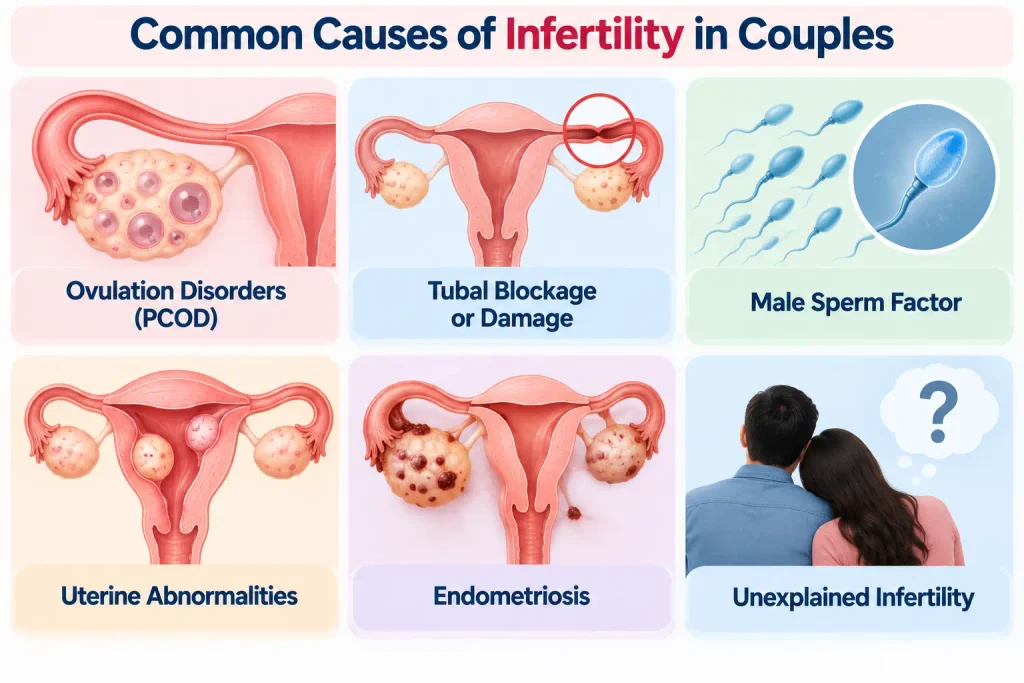
The causes of infertility span both partners and several different systems, hormonal, structural and functional. Identifying the specific cause is the foundation of any meaningful treatment plan.
Ovulation Disorders
Irregular or absent ovulation is one of the most common causes of female infertility. Without a regularly released egg, the window for conception is unpredictable or absent. PCOD is the leading cause of ovulation-related infertility in women of reproductive age. Thyroid dysfunction and elevated prolactin also suppress ovulation. All of these are identifiable through blood tests, and in a significant number of cases ovulation can be restored or supported with targeted treatment once the specific cause is confirmed.
Learn more about how we diagnose and manage this condition through our targeted PCOD treatment in Rewa.
Tubal Factors
The fallopian tubes carry the egg from the ovary to the uterus and are the site where fertilisation normally occurs. Blocked, damaged or scarred tubes, from previous pelvic infection, endometriosis or prior surgery, prevent the egg and sperm from meeting. Tubal assessment is included in the infertility evaluation where the clinical history suggests a tubal cause. Where tubal blockage is confirmed, the discussion about next steps follows from the degree and location of the blockage.
Uterine Factors
Structural abnormalities within the uterus, including fibroids that distort the cavity, uterine polyps, adhesions within the cavity or a uterine septum, can affect implantation and early pregnancy. These are assessed through pelvic sonography and, where the scan raises further questions, through hysteroscopy which provides a direct view of the uterine interior.
Endometriosis
Endometriosis is found in a significant proportion of women with unexplained infertility. It can affect the ovaries, fallopian tubes and the pelvic environment in ways that reduce the likelihood of conception. Where the clinical history suggests endometriosis, severe period pain, painful intercourse or an endometrioma on scan, this is assessed as part of the infertility evaluation.
Male Factor
Semen analysis assesses sperm count, motility and morphology. Abnormalities in any of these parameters reduce the likelihood of fertilisation. Male factor infertility is common, frequently underdiagnosed and often not investigated at all until the female partner’s evaluation has been completed. At Adarsh Hospital, semen analysis is arranged alongside the female evaluation from the outset so that the clinical picture is complete from the start.
Unexplained Infertility
In a proportion of couples, a thorough evaluation returns results within normal limits for both partners and no specific cause is identified. This is described as unexplained infertility. It does not mean nothing is wrong. It means the available investigations have not identified the cause. The treatment options in this situation are discussed based on the couple’s age, how long they have been trying and their overall clinical profile.
Recurrent Pregnancy Loss
Two or more early pregnancy losses warrant a specific evaluation that goes beyond the standard infertility workup. The causes include uterine structural abnormalities, clotting disorders such as antiphospholipid syndrome, chromosomal factors in either partner, thyroid dysfunction and inadequate progesterone support in early pregnancy. At Adarsh Hospital, couples with recurrent pregnancy loss are assessed for these specific factors rather than approached as straightforward infertility.
How We Evaluate Infertility at Adarsh Hospital, Rewa
The evaluation follows a structured sequence. It begins with a consultation, proceeds through targeted investigations and arrives at a clear clinical picture before any treatment is discussed.
- First Consultation — Both Partners Together: Dr. Richa Patel sees both partners at the initial consultation. A detailed history covers how long the couple has been trying, the frequency of intercourse, the woman’s cycle pattern and menstrual history, any previous pregnancies or pregnancy losses, any previous investigations, current medications and relevant medical history for both partners. This shapes the investigation plan.
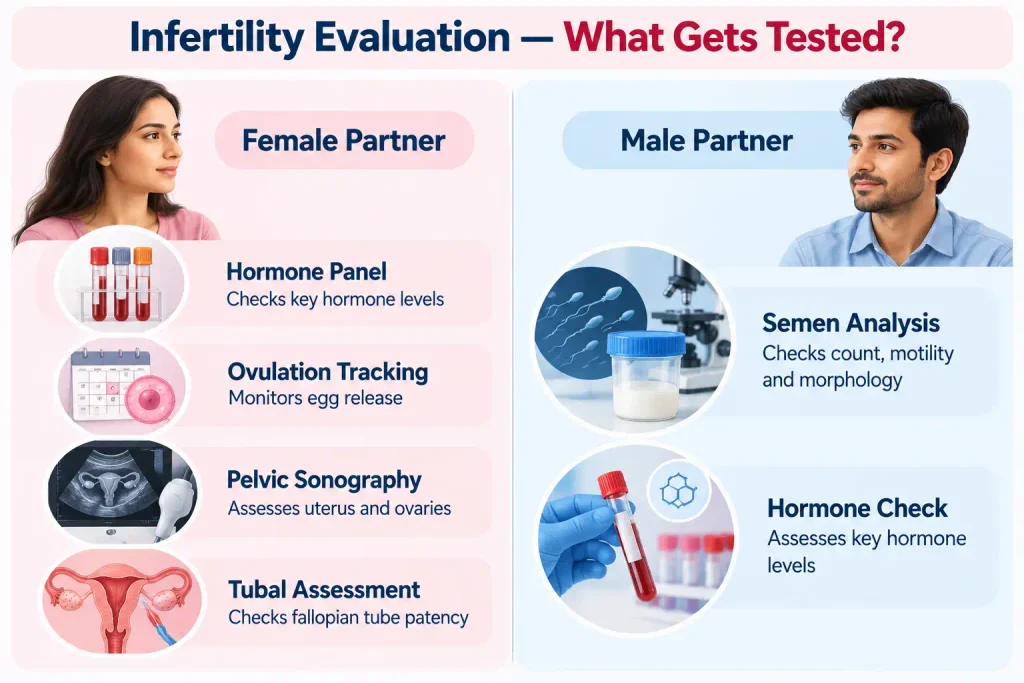
- Female Partner — Hormone Blood Tests: Tests typically include FSH and LH (ovarian function and pituitary signalling), AMH (anti-Mullerian hormone, reflecting ovarian reserve), oestradiol, prolactin, TSH (thyroid function) and progesterone timed to the luteal phase to confirm whether ovulation has occurred. These are processed in the in-house laboratory at Adarsh Hospital.
- Female Partner — Pelvic Sonography: A pelvic ultrasound assesses the uterus and both ovaries, including uterine shape and cavity, ovarian size, antral follicle count as a measure of ovarian reserve, and any structural findings such as fibroids, polyps, an endometrioma or a polycystic ovary pattern. Sonography is available in-house so the scan and consultation can be coordinated on the same visit where appropriate.
- Female Partner — Ovulation Tracking: Where the history or initial blood tests suggest irregular ovulation, a monitored cycle using serial sonography at specific points tracks whether a dominant follicle is developing and whether it releases an egg. This is more definitive than a single progesterone test alone and guides what ovulation support, if any, is appropriate.
- Female Partner — Tubal Assessment: Where the clinical history raises the possibility of tubal damage, tubal patency is assessed through a hysterosalpingogram or through laparoscopy where this is indicated for other clinical reasons as well.
- Male Partner — Semen Analysis: A semen sample is analysed for count, motility and morphology after 2 to 5 days of abstinence. Where the first analysis is abnormal, a repeat test is arranged before conclusions are drawn, as parameters can vary. Where results are significantly abnormal, further evaluation and coordination with the appropriate specialist is discussed at the follow-up consultation.
In-House Investigations We Offer
A direct answer matters here because couples deserve to know what they can access locally before making decisions about where to go for their evaluation.
At Adarsh Hospital, the following are available in-house: hormone blood tests covering FSH, LH, AMH, prolactin, TSH, progesterone and oestradiol processed in the on-site laboratory; pelvic sonography for uterine and ovarian assessment; serial ovulation tracking scans; semen analysis for the male partner; and hysteroscopy for direct assessment of the uterine cavity. Surgical investigation and treatment through laparoscopy is available for identifiable structural causes such as endometriosis, fibroids and ovarian cysts. See how we use advanced camera technology to diagnose and treat these conditions through laparoscopy and hysteroscopy at Adarsh Hospital.
IVF and advanced assisted reproductive techniques are not offered at Adarsh Hospital. Where the evaluation findings indicate that IVF or a higher level of assisted reproduction is the appropriate next step, Dr. Richa Patel discusses this clearly and coordinates the onward referral based on the couple’s specific findings. The evaluation completed at Adarsh Hospital provides the clinical documentation needed for that referral without requiring the couple to repeat the same investigations elsewhere.
Our Treatment Options for Infertility
Treatment follows directly from the findings. There is no standard infertility treatment that applies to every couple. What is appropriate depends on what the evaluation found, the age of both partners, how long they have been trying and what is available at Adarsh Hospital for their specific situation.
| Cause identified | Treatment approach at Adarsh Hospital |
|---|---|
| PCOD with ovulation disorder | Ovulation induction with medication; monitored cycles with serial sonography |
| Thyroid or prolactin abnormality | Medical treatment of the hormonal cause; reassessment of ovulation once normalised |
| Uterine fibroid distorting cavity | Laparoscopic or hysteroscopic fibroid removal; reassessment after recovery |
| Uterine polyp | Hysteroscopic removal; reassessment after recovery |
| Endometriosis | Medical or laparoscopic surgical management; fertility discussion based on extent |
| Tubal blockage | Discussion of available options; onward coordination where indicated |
| Male factor abnormality | Lifestyle guidance; onward coordination with appropriate specialist based on severity |
| Unexplained infertility | Options discussed based on age, duration and clinical profile of both partners |
Emotional Wellbeing During Infertility Assessment
Difficulty conceiving over a prolonged period carries significant emotional weight for both partners. This is acknowledged at Adarsh Hospital without reducing it to a checklist item. Realistic expectations are set from the beginning because false reassurance at an early stage causes more harm than a clear, honest picture of what the evaluation has found and what the options are from that point.
According to the WHO fact sheet on infertility, it is a global public health concern affecting millions of couples, with causes distributed across both partners. Assessment of both partners from the outset reflects current clinical best practice and is the approach taken at Adarsh Hospital.
Meet Your Infertility Specialist: Dr. Richa Patel
Dr. Richa Patel (MBBS, DGO) is the Director of Adarsh Hospital and Research Centre, Rewa, with over 21 years of clinical experience in obstetrics and gynaecology. Infertility evaluation, covering both straightforward hormonal causes and more complex pelvic conditions including endometriosis and uterine structural abnormalities, forms a regular part of her practice. Her approach is structured, honest and grounded in what the individual couple’s findings show.
- MBBS, DGO — Consultant Obstetrician and Gynaecologist
- Director, Adarsh Hospital and Research Centre, Rewa
- 21+ years of clinical practice; 10,000+ laparoscopic procedures performed
- OPD: Monday to Sunday, 11:00 AM to 1:00 PM and 5:00 PM to 7:00 PM
For a broader overview of everything we offer, explore our complete range of gynaecology services in Rewa.
Book Your Consultation Today
Both partners should attend the first consultation together wherever possible. Calling ahead on +91 74155 61672 reduces waiting time, particularly if you are travelling from Satna, Mauganj or surrounding areas. Bring any previous blood reports, sonography films, semen analysis reports and a note of any medicines either partner is currently taking. If either partner has had previous surgery relevant to this concern, bring those operation notes too.

- Phone / WhatsApp: +91 74155 61672
- OPD: Monday to Sunday, 11:00 AM to 1:00 PM and 5:00 PM to 7:00 PM
- Address: Near New Bus Stand, Saman Naka, Opposite the Water Tank, Sanjay Nagar, Rewa, Madhya Pradesh 486001
Infertility treatment in Rewa at Adarsh Hospital starts with understanding what is actually happening for both partners. The plan follows from the findings, not from assumptions about who the problem belongs to or what the most common answer turns out to be statistically.
Frequently Asked Questions
1. When should a couple seek infertility evaluation?
The clinical guideline is to seek evaluation after 12 months of regular unprotected intercourse without achieving pregnancy, or after 6 months if the woman is above 35, since ovarian reserve declines with age. Earlier evaluation is appropriate if the woman has irregular or absent periods, a known diagnosis of PCOD or endometriosis, a history of pelvic infection or previous reproductive surgery, or if there is a known male factor concern such as a previous abnormal semen analysis. Recurrent miscarriage, two or more early pregnancy losses, also warrants evaluation rather than continued attempts without investigation.
2. Does infertility evaluation have to start with the woman?
No, and ideally it should not. A semen analysis for the male partner is one of the simplest and most informative tests in a fertility workup and should be arranged at the outset alongside the female partner’s hormone tests. Waiting to complete a full female evaluation before testing the male partner delays the picture by weeks or months in cases where the primary or contributing factor is male. At Adarsh Hospital, both partners are assessed from the first consultation so that the clinical picture is complete before any treatment direction is discussed.
3. What does a semen analysis actually measure?
A semen analysis measures three primary parameters: count (the number of sperm per millilitre of semen), motility (the percentage of sperm that are moving, and how well they move), and morphology (the percentage of sperm with a normal shape). The volume of the semen sample and its pH are also recorded. A single abnormal semen analysis is not a definitive finding. Parameters can vary significantly based on recent illness, abstinence period and other factors. A repeat analysis after 2 to 4 weeks is usually arranged before conclusions are drawn from an abnormal first result.
4. Can PCOD be treated to support conception?
Yes. PCOD is one of the most common and most treatable causes of ovulation-related infertility. Where PCOD is confirmed as the reason ovulation is irregular or absent, ovulation induction using medication to stimulate the ovaries to develop and release an egg is the primary treatment approach. The cycle is monitored with serial sonography to track follicle development and confirm ovulation. This is available at Adarsh Hospital. No specific pregnancy outcome can be promised, and the plan is adjusted based on what the monitored cycles show over time.
5. What is AMH and what does it tell us about fertility?
AMH, anti-Mullerian hormone, is a blood test that reflects ovarian reserve, which is the number of eggs remaining in the ovaries. A low AMH suggests reduced ovarian reserve, meaning fewer eggs available for ovulation or fertility treatment. A high AMH is seen in women with PCOD, who have many follicles but may not be ovulating them regularly. AMH tells us about quantity rather than egg quality and is interpreted alongside the clinical history, other hormone tests and the antral follicle count on sonography. It is one piece of the picture, not the whole picture.
6. Is there any treatment for unexplained infertility?
Yes, options exist even when a thorough evaluation finds no specific cause. Unexplained infertility is a recognised clinical category accounting for a proportion of couples who seek fertility assessment. Options discussed depend on the couple’s age, how long they have been trying and their clinical profile. In younger couples with a shorter duration of trying, monitored cycles with timed intercourse may be the first step. In other situations, ovulation induction or onward referral for IVF may be discussed. The honest position is that what is appropriate depends on the specific couple, and there is no single answer for all cases of unexplained infertility.
7. Is IVF available at Adarsh Hospital in Rewa?
IVF and advanced assisted reproductive techniques are not offered at Adarsh Hospital. The evaluation, diagnosis and a significant range of treatments for infertility are available here, including ovulation induction, surgical management of structural causes such as fibroids, polyps and endometriosis, and laparoscopy and hysteroscopy. Where the findings indicate that IVF is the most appropriate next step, Dr. Richa Patel discusses this clearly and coordinates an onward referral. The clinical documentation from the Adarsh Hospital evaluation is provided so the couple does not need to repeat the same investigations at the referral centre.
8. We have had two miscarriages. Should we come in for an infertility evaluation?
Yes. Recurrent pregnancy loss, two or more miscarriages, warrants a specific evaluation that goes beyond the standard infertility workup. The causes of recurrent miscarriage include uterine structural abnormalities such as a uterine septum, polyp or adhesions within the cavity, clotting disorders such as antiphospholipid syndrome, chromosomal factors in either partner, thyroid dysfunction and inadequate progesterone support in early pregnancy. The evaluation at Adarsh Hospital for couples with recurrent pregnancy loss covers these specific factors. Recurrent miscarriage and infertility sometimes share causes and the same couple may present with both concerns.
9. How long does infertility treatment take before results can be assessed?
The timeline depends entirely on the cause and the treatment chosen. Where ovulation induction is used for PCOD-related infertility, the response is assessed over three to six monitored cycles before the plan is reviewed. Where a structural cause such as a fibroid or polyp has been surgically treated, fertility assessment begins after a recovery period of two to three months. Where the cause involves coordination with a specialist fertility centre, the timeline depends on that process. Each stage of the evaluation and treatment has a defined review point, and this is communicated clearly at each consultation rather than left open-ended.
10. Does stress cause infertility?
Significant chronic stress can affect the hormonal axis that regulates ovulation in women, and there is some evidence it affects sperm parameters in men. However, stress is also one of the most commonly cited and most frequently incorrect explanations given to couples experiencing infertility. In a large proportion of cases where infertility has a clinical cause, that cause is identifiable through proper investigation and is not primarily stress related. Telling a couple that stress is the reason, without investigating properly, delays the identification of a treatable cause. Stress management supports overall wellbeing during fertility treatment but it is not a diagnosis and should not substitute for a proper evaluation.