
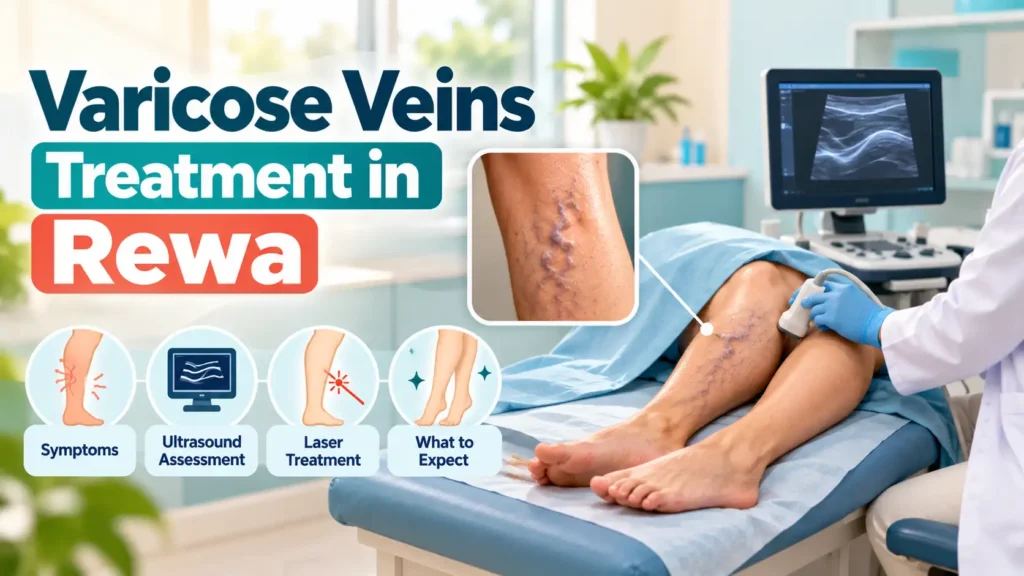
Aching, heavy legs at the end of a long day are easy to brush off as just tiredness. But when a twisted blue vein starts to bulge under the skin of your calf, and that heavy feeling no longer goes away after a good night’s sleep, it’s time to pay attention. These are the classic signs of varicose veins. When patients visit our clinic for varicose veins treatment in Rewa, they are often surprised to learn that treating these veins doesn’t require massive surgery. While veins that cause no trouble can sometimes just be watched, those causing pain, swelling, or skin changes can now be safely closed using advanced, minimally invasive laser treatments.
Varicose Veins Symptoms: Visible Leg Veins in Rewa, Heaviness and Night Cramps
Varicose veins are swollen, twisted veins under the skin, usually in the legs, that form when the one way valves inside the veins stop working properly. Blood then pools and presses on the vein wall. They may cause aching, heaviness and swelling, and they do not always need treatment.
- Visible leg veins that look blue or dark purple, and they may feel lumpy, bulging or twisted.
- Leg heaviness that is typically worse after long hours of standing and eases when you walk or lift your feet.
- Swollen leg veins may throb, burn or feel tender, especially in warm weather.
- Leg cramps and veins often go together, with cramps showing up at night.
- Swollen feet and ankles by the evening.
- Dry, itchy or thin skin over the affected vein.
The NHS varicose veins page notes that symptoms are usually worse after long periods of standing and often improve with walking, rest and raising the legs, and that varicose veins may worsen slowly over several years without treatment.
Spider Veins, Reticular Veins and Varicose Veins: Not the Same Thing
| Type of vein | How it looks | Does it usually cause symptoms? |
|---|---|---|
| Spider veins (telangiectasia) | Tiny red or blue clusters on the skin surface | Usually harmless, and often a cosmetic concern |
| Reticular veins | Flat blue green veins just under the skin | May cause mild discomfort in some patients |
| Varicose veins | Raised, twisted, bulging veins | Can cause aching, heaviness, swelling and skin changes |
Ankle Skin Changes: Signs That the Veins Need Attention
Long standing pressure in the veins can affect the skin near the ankle. Ankle skin changes are a reason to be assessed sooner rather than later.
- Brown or darker patches of skin around the ankle.
- Itchy, red, flaky skin known as varicose eczema.
- Hardened, tight skin above the ankle.
- A sore or ulcer that is slow to heal.
A bleeding varicose vein, a hard and painful vein, sudden swelling of one leg, or breathlessness or chest pain needs urgent medical attention. Press firmly on a bleeding vein, raise the leg and seek care at once.
What Causes Varicose Veins: Faulty Valves, Standing and Family History
Veins in the legs carry blood back to the heart against gravity, and small valves stop it from flowing backwards. When a valve fails, blood leaks down, builds up and stretches the vein until it swells and twists.
- A close family member with varicose veins.
- Pregnancy, because of hormones and pressure from the growing womb.
- Being overweight.
- Standing or sitting still for long hours at work.
- Increasing age.
- An earlier leg injury or blood clot.
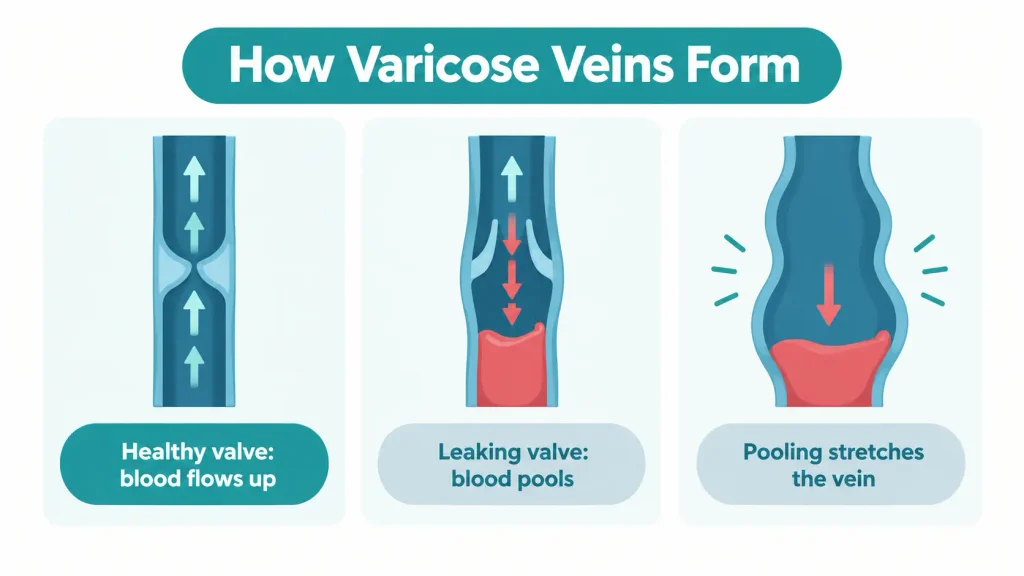
Venous Insufficiency: When the Valves Keep Leaking
Chronic venous insufficiency is the medical name for veins that cannot return blood efficiently. It is the underlying cause of most varicose veins, and when it continues for years it can lead to swelling, skin changes and ulcers. That is why a specialist looks beyond the visible veins to the deeper source of the leak.
Venous Assessment and Duplex Ultrasound: How a Specialist Plans Treatment
A varicose veins consultation begins with your story, and a varicose vein specialist in Rewa will usually examine your legs while you stand. The NHS says specialists usually use a test called a duplex ultrasound to confirm varicose veins and plan treatment.
- History: symptoms, family history, pregnancies, earlier clots or procedures, and how the veins affect your daily life.
- Standing examination: the veins, skin colour, swelling and any ulcers are checked.
- Duplex ultrasound: a scan that shows the veins and the direction of blood flow, which identifies the valves that leak.
- Check of the deep veins: to make sure the deeper system is open, because that affects what is safe to treat.
- Treatment discussion: your goals, your health, the options and what each can and cannot do.
This venous assessment matters because treating the surface veins without locating the leaking source often leads to quick recurrence.
When Varicose Veins Need Treatment: Symptoms and Complications That Change the Plan
The NHS explains that varicose veins do not always need treatment. A doctor may recommend a procedure in these situations.
- Pain, heaviness, swelling or itching that interferes with daily life.
- Skin changes such as eczema or darker patches.
- A venous ulcer, or an ulcer that has healed but may return.
- Bleeding from a vein.
- A hard, tender vein caused by inflammation or a clot in a surface vein.
Some patients seek treatment for appearance alone. That is a personal choice, and your specialist will discuss it openly, along with the costs and what can realistically be achieved.
Self Care and Compression: What Eases Symptoms While You Decide
- Walk regularly and avoid standing or sitting in one position for long.
- Raise your legs when resting.
- Keep your weight in a healthy range.
- Wear compression stockings if your doctor advises them, because they may ease aching and swelling.
These measures can ease symptoms, yet they do not remove existing varicose veins.
Varicose Veins Treatment in Rewa: Vein Treatment Options Compared
Treatment for enlarged leg veins ranges from simple self care to a procedure that closes or removes the faulty vein. A PubMed review of trials comparing heat based ablation with foam sclerotherapy found that anatomical success appeared higher with ablation, while clinical success and patient reported outcomes were similar and complication rates were low for both.
| Option | How it works | Usually considered when | Points to discuss |
|---|---|---|---|
| Compression stockings and self care | Gentle pressure supports the veins and eases symptoms | Mild symptoms, during pregnancy, or while waiting for a procedure | Does not remove the veins |
| Endovenous laser ablation | A laser fibre heats and closes the leaking main vein | A confirmed leaking trunk vein suitable for the method | Usually local anaesthesia, with bruising and tightness afterwards |
| Radiofrequency ablation | Radiofrequency energy heats and closes the vein | Similar to laser, depending on the vein and the surgeon | Similar points to laser |
| Foam sclerotherapy | A special foam is injected to close the vein | Ablation is unsuitable, or smaller and branch veins need treating | Repeat sessions may be needed, and rare serious side effects are described |
| Phlebectomy | Surface veins are removed through tiny cuts | Bulging branch veins | Small marks and bruising |
| Ligation and stripping | The faulty vein is tied off and removed surgically | Other options are unsuitable | A longer recovery and anaesthesia |
Varicose Veins Laser Treatment in Rewa: How the Laser Vein Procedure Works
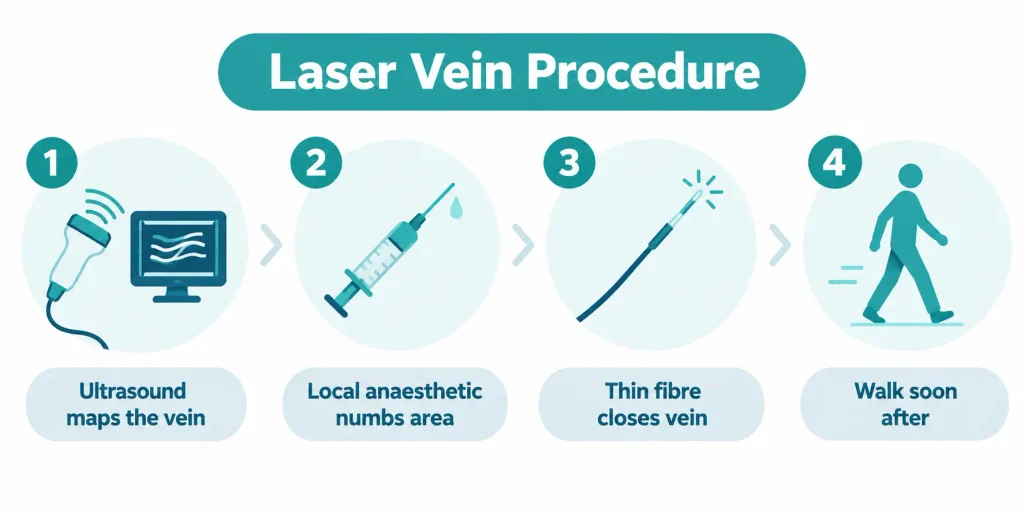
Endovenous laser ablation belongs to the family of laser surgery in Rewa procedures, and it treats the vein from the inside through a tiny puncture instead of a long cut.
- Mapping: the leaking vein is marked using ultrasound.
- Numbing: local anaesthetic is placed along the vein, and a tiny puncture is made.
- Fibre placement: a thin laser fibre is guided into the vein under ultrasound.
- Treatment: laser energy is delivered as the fibre is slowly withdrawn, heating the vein wall so that it closes.
- Check: an ultrasound confirms that the vein has closed.
- Dressing: a dressing and a compression stocking or bandage are applied, and you are encouraged to walk soon after.
Once the faulty vein is closed, blood is directed through healthy veins, and the treated vein is gradually absorbed by the body over time.
Who May Not Be Suitable for Laser Vein Treatment
- Pregnancy, when procedures are usually postponed.
- A recent or active blood clot in the deep veins.
- Very twisted or small veins that the fibre cannot pass through.
- Poor blood flow to the legs from arterial disease.
- Infection in the skin over the treatment area.
Your specialist decides after the ultrasound, and another option may suit you better.
Varicose Vein Surgery: When Ligation, Stripping or Phlebectomy Are Used
Varicose vein surgery still has a place when other methods are unsuitable, when veins are very large or twisted, or when branch veins need removing. A surgeon may combine methods, for example closing the main vein with laser and removing bulging branches through tiny cuts.
Risks and Limits to Discuss Before Any Vein Procedure
Vein procedures are widely performed, yet all procedures carry risk. Before any procedure, our surgical team will sit down with you to clearly explain the potential risks:
- Bruising, tightness or pain along the treated vein for some time.
- Skin discolouration or a patch of numbness near the treated area.
- Inflammation of a surface vein.
- A blood clot in the deep veins, which is uncommon but serious.
- Infection, or a vein that fails to close fully.
- New varicose veins forming later, because the underlying tendency remains.
Ask which vein is leaking, why a method is advised for it and how recurrence is handled. You are free to take time or seek a second opinion.
Recovery After Vein Treatment: Walking, Stockings and Follow Up
Recovery depends on the method, the number of veins treated and your general health. Most of these procedures are carried out under local anaesthetic, and your specialist will tell you when you can return to work and exercise.
- Walk regularly from the day of the procedure as advised.
- Wear the compression stocking or bandage for as long as you are told.
- Take pain relief as advised, and avoid hot baths and long journeys until allowed.
- Raise your legs when sitting.
- Avoid heavy lifting and strenuous exercise until your specialist agrees.
- Attend the follow up scan or visit to check that the vein has closed.
Warning Signs After a Vein Procedure
- Pain, swelling and redness in the calf that keeps increasing.
- Breathlessness or chest pain, which needs emergency care at once.
- Bleeding that does not stop with firm pressure.
- Spreading redness, heat, pus or fever.
Call the hospital, or go to the nearest emergency department, if any of these appear.
Getting Ready for Your Vein Procedure
- Tell the doctor about all medicines, especially blood thinners, and about allergies and any earlier clots.
- Wear loose clothing and avoid applying creams to the legs on the day.
- Bring earlier scan reports.
- Arrange for someone to accompany you home.
- Ask how long the stockings must be worn and when you can return to work.
Habits That Ease Heavy Legs and Slow Further Vein Problems
- Move your legs often, and avoid standing or sitting still for hours.
- Raise your legs when resting.
- Keep your weight in a healthy range.
- Wear compression stockings if advised.
- See a doctor early for skin changes, because they signal a longer standing problem.
Booking a Varicose Veins Consultation at Adarsh Hospital
If your legs feel heavy, the veins keep bulging or the skin near the ankle is changing, an assessment will show whether you need treatment now, later or not at all. The surgical team at Adarsh Hospital provides general and laparoscopic surgery in Rewa, so related surgical conditions can be assessed in the same visit.
- A list of your medicines and allergies.
- Earlier scans or reports, including any ultrasound of the legs.
- A short note of when the symptoms began, what makes them worse and what eases them.
This content gives general information and does not replace an examination by a qualified doctor.
Whether your plan turns out to be stockings and self care or varicose veins treatment in Rewa with a procedure, a proper scan comes first. Book a consultation, bring your questions, and decide with your specialist at your own pace.
Frequently Asked Questions
1. Do varicose veins need treatment?
Not always. The NHS says varicose veins do not always need treatment, and that they often worsen only slowly over several years. Varicose veins treatment in Rewa is usually advised when the veins cause pain, heaviness, swelling, itching, skin changes, bleeding or an ulcer. If your veins cause no trouble, a specialist may suggest self care and regular review. Have the legs assessed if symptoms change, because skin changes and ulcers are signs of a longer standing problem.
2. Can varicose veins go away on their own?
Existing varicose veins do not usually disappear by themselves, because the valves that failed do not repair themselves. Symptoms can improve with walking, rest, leg elevation, weight control and compression stockings, but the veins usually remain. Without treatment they may slowly worsen over several years. A duplex ultrasound shows which veins are leaking and whether a procedure would help. Early assessment is sensible if you notice skin changes or growing discomfort.
3. Is laser treatment for varicose veins painful?
Local anaesthetic is placed around the vein, so most patients feel pressure rather than sharp pain during the procedure. Afterwards, tightness, bruising and tenderness along the treated vein can occur, and the level differs from person to person. Your specialist will advise on pain relief, walking and the compression stocking. Pain that keeps increasing, or a swollen, red calf, needs prompt review because it can signal a complication.
4. How long does recovery take after varicose vein laser treatment?
Recovery depends on the method, the number of veins treated and your health. These procedures are often carried out under local anaesthetic, and patients are usually encouraged to walk soon afterwards. You may need to wear a compression stocking for a period and avoid strenuous exercise or long journeys for a while. Your specialist will tell you when you can return to work and exercise, and when your follow up scan will take place.
5. Can varicose veins come back after treatment?
They can. Treatment closes or removes the veins that are leaking, but the tendency to develop varicose veins, which can come from family history, pregnancy or long standing, remains. New veins may form later, and some treated veins may not close fully. Your specialist can lower the chance by treating the leaking source and by advising on movement, weight and stockings, but no procedure can promise that varicose veins will never return.
6. Is varicose vein laser treatment safe?
Endovenous laser ablation is a widely used procedure when it is offered to suitable patients after a duplex ultrasound. No procedure is free of risk. Possible problems include bruising, tightness, skin discolouration, inflammation of a surface vein, infection, numbness and, rarely, a blood clot in the deep veins. Safety depends on careful selection, technique and aftercare. Ask your specialist how the risks apply to you and what the alternatives are.
7. What is the difference between spider veins and varicose veins?
Spider veins are tiny red or blue clusters on the skin surface. The NHS describes them as harmless, and they do not bulge under the skin. Varicose veins are larger, raised, twisted veins that can cause aching, heaviness, swelling and skin changes. Treatment for spider veins is often for appearance, while varicose veins may need assessment and a duplex ultrasound. A specialist can tell you which type you have and what each needs.
8. Do compression stockings cure varicose veins?
No. Compression stockings squeeze the legs gently and can ease aching, heaviness and swelling, but they do not close or remove the faulty veins. They are useful during pregnancy, while you wait for a procedure, or when a procedure is not suitable. They work best when worn as your doctor advises and combined with walking, leg elevation and weight control. Ask your specialist which type and strength suit your legs.
9. Which doctor should I see for varicose veins in Rewa?
A varicose vein specialist in Rewa, usually a vascular or general surgeon trained in vein procedures, can examine your legs, arrange a duplex ultrasound and explain your options. Bring a list of your medicines, earlier scan reports and a note of your symptoms. A family physician can start the assessment and refer you, and you should seek urgent care for a bleeding vein, a leg ulcer or sudden swelling of one leg.
10. How much does varicose veins treatment cost?
The cost of varicose veins treatment in Rewa depends on the method, the number of veins and legs treated, the scans, the anaesthesia, the stockings and the follow up. A reliable figure cannot be given without an examination and a duplex ultrasound. After your consultation, ask the hospital billing desk for a written estimate that lists what is included, so you can plan ahead and ask questions before you decide.