


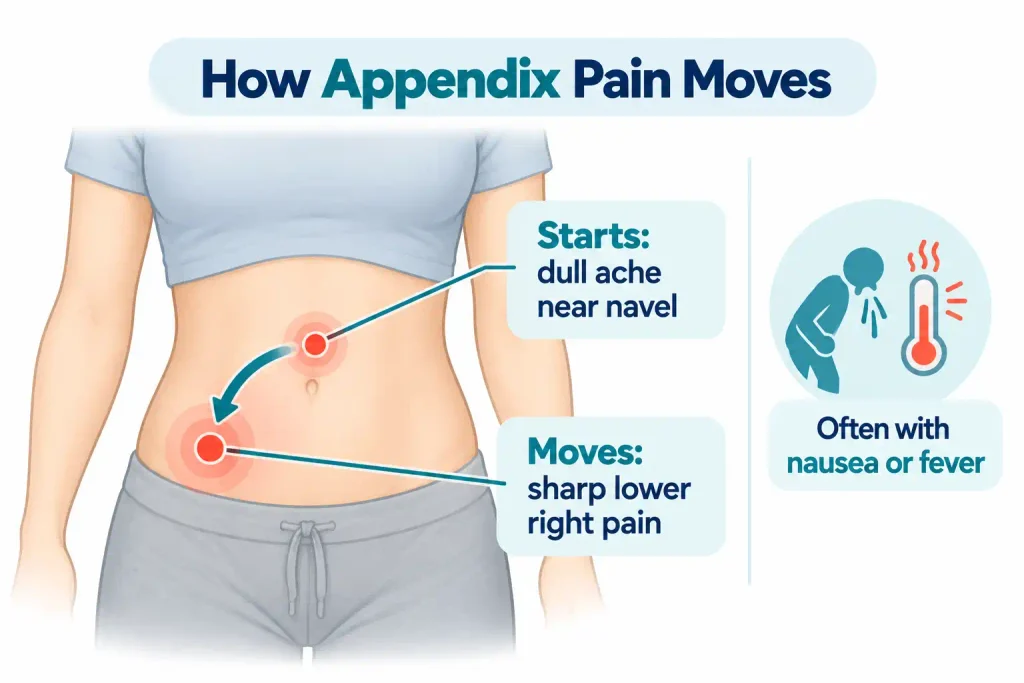
A stomach ache is usually nothing to worry about, but appendicitis often begins as a vague ache around your navel that is incredibly easy to mistake for simple indigestion. Within a few hours, however, that pain typically shifts to the lower right abdomen and becomes intensely sharp. That is the moment most patients realize something is seriously wrong. Because an inflamed appendix can burst if left untreated, appendix surgery in Rewa is most often performed as an urgent, same-day operation. If you or a family member are experiencing these sudden symptoms, getting a proper, immediate examination is the most important step you can take.
Appendix Symptoms: How the Pain Moves and Which Signs to Act On
Appendicitis is swelling and infection of the appendix, a small pouch attached to the large intestine. It usually causes pain that starts near the navel and shifts to the lower right abdomen, with nausea and fever. Surgery to remove the inflamed appendix is the usual treatment and is often urgent.
- Intense lower right abdominal pain is the classic hallmark sign. It is usually much sharper and steadier than the initial stomach ache.
- Nausea and abdominal pain together, often with vomiting after the pain begins.
- Loss of appetite, which is often one of the earliest changes.
- A mild fever that may rise as the infection builds.
- Pain that worsens with walking, coughing, jolts or pressing and releasing the area.
- Bloating, constipation or loose stools in some patients.
Why the Pain Moves From the Navel to the Right Side
Early inflammation irritates the nerves around the navel, so the pain feels vague and central. As the swelling grows, it inflames the lining of the abdominal cavity over the lower right side, and the pain becomes sharp and easy to point to with one finger. The Mayo Clinic notes that pain which worsens when pressure is released is a typical clue during examination.
When the Usual Pattern Does Not Appear
The NHS points out that some patients with appendicitis do not have the usual pain symptoms. These groups need particular care.
- Pregnant women, because the appendix can sit higher in the abdomen.
- Young children, who may only seem unwell, refuse food or cry when moved.
- Older adults, who may have milder pain and less fever.
- Patients whose appendix lies behind the bowel, who may feel pain in the back or flank.
Warning Signs That Need an Emergency Appendix Assessment
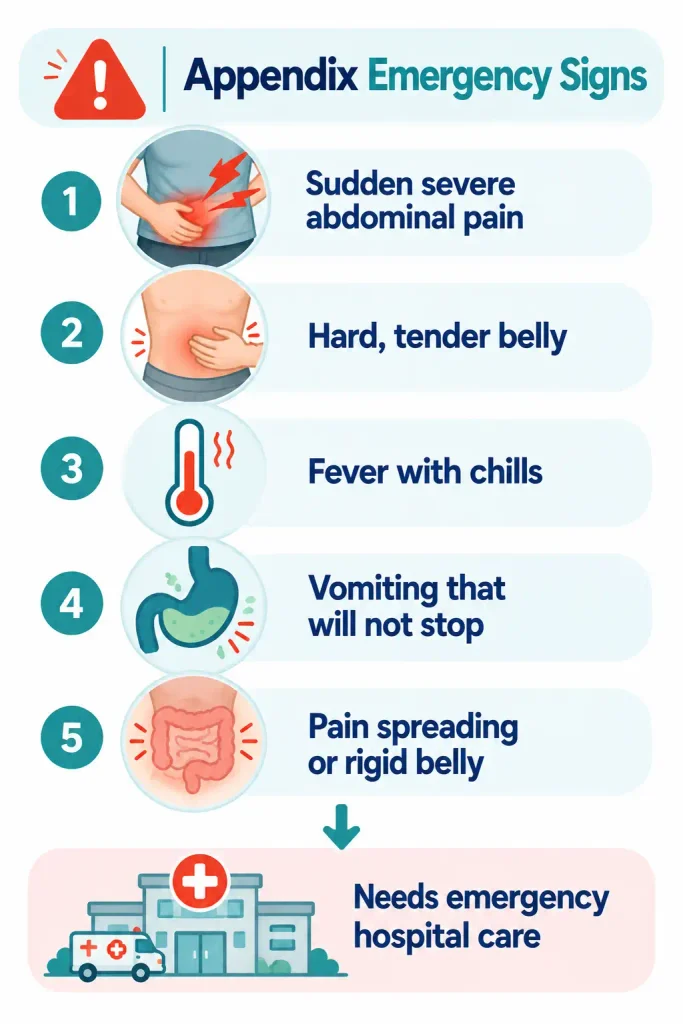
Severe or spreading abdominal pain, a rigid belly, high fever with chills or repeated vomiting needs an emergency appendix assessment at once. These signs can mean the appendix has burst or is close to bursting.
- Pain that suddenly becomes severe, or suddenly eases and then spreads across the abdomen.
- A hard, tender belly that hurts to touch.
- Fever, shivering or a fast heartbeat.
- Vomiting that does not stop.
Appendicitis Diagnosis: What Happens During an Emergency Appendix Assessment
Appendicitis diagnosis is mainly clinical, which means the doctor relies first on your story and an examination. The NHS says a doctor will feel your abdomen for pain and swelling, and that some patients are observed for a few hours before a decision is made.
- History: when the pain started, where it moved, vomiting, fever, bowel habits and, for women, periods and pregnancy.
- Examination: tenderness in the lower right abdomen, pain on pressing and releasing, and signs that the abdominal lining is irritated.
- Blood tests: the white cell count and markers of inflammation can point towards infection.
- Urine test: to look for a urine infection or a kidney stone that can mimic appendicitis.
- Imaging: an ultrasound is often used first, especially in children, young women and pregnancy, and a CT scan may be added in adults when the picture is unclear.
- Observation: repeated examinations over a few hours when the diagnosis is uncertain.
An appendicitis consultation with a surgeon is also useful for patients with repeated right sided pain that settles on its own, because the cause deserves a proper answer.
Conditions That Can Mimic Appendicitis
| Condition | How it can look similar | Clues a doctor checks |
|---|---|---|
| Gastroenteritis | Cramping pain, nausea and vomiting | Diarrhoea is usually more prominent, and pain is less fixed on the right |
| Urine infection or kidney stone | Pain in the flank or lower abdomen | Burning or blood in urine and urine test results |
| Ovarian cyst or other pelvic condition | Lower right pain in women | Pelvic examination, pregnancy test and ultrasound |
| Swollen glands in the abdomen | Right sided pain in children after an infection | Recent sore throat or cold, and ultrasound |
| Inflammatory bowel disease | Pain in the lower right abdomen | Long standing symptoms, blood in stool and scans |
When the cause lies elsewhere in the abdomen, a surgeon may discuss a different route, which can include abdominal surgery in Rewa for conditions that need an operation.
Appendicitis Treatment in Rewa: Surgery, Antibiotics and When Each Is Considered
The NHS appendicitis page explains that appendicitis is usually treated with surgery to remove the appendix, and that it needs urgent treatment in hospital because the appendix can burst if treatment is delayed. The approach still depends on how advanced the infection is.
| Situation | Usual approach | Points to discuss |
|---|---|---|
| Suspected acute appendicitis | Urgent surgery to remove the appendix, with antibiotics | Keyhole or open method, and anaesthesia |
| Mild, uncomplicated appendicitis in selected patients | Antibiotics alone may be considered | Close monitoring, and the chance that appendicitis returns or surgery is needed later |
| Burst appendix or abscess | Surgery to clean the abdomen, or drainage of the abscess, with antibiotics | A longer stay and a higher chance of complications |
| Appendix mass, a lump of bowel stuck to the inflamed appendix | Antibiotics first, sometimes with surgery weeks later | Timing of the planned operation |
Waiting at home for the pain to settle is the riskiest option once the pain is localised and worsening. A surgeon can judge which pathway fits you, and that decision is best made early.
Appendix Surgery in Rewa: How Keyhole and Open Appendectomy Work
An appendix operation in Rewa, also called appendectomy in Rewa or appendix removal, can be done through small keyhole cuts or one larger open cut. The Mayo Clinic appendectomy guide says keyhole surgery generally allows faster recovery with less pain and scarring, although it is not suited to all patients. The approach follows the same principles as laparoscopic surgery in Rewa for other abdominal conditions.
Laparoscopic Appendix Surgery in Rewa: The Steps
- You receive general anaesthesia, and antibiotics are usually given.
- A small cut near the navel allows the abdomen to be gently inflated with gas, and the camera is passed in.
- Two or three more small cuts allow thin instruments to be placed.
- The surgeon finds the inflamed appendix and checks the surrounding bowel.
- The blood supply and the base of the appendix are secured with clips, a stapler or a loop, and then divided.
- The appendix is placed in a bag and removed through one of the cuts.
- Any pus is washed out, the gas is released, and the cuts are closed. A drain is placed only if the surgeon thinks it is needed.
Open Appendectomy: When and How
In an open appendectomy, the surgeon makes one cut over the lower right abdomen, removes the appendix and closes the layers. The Mayo Clinic notes that it allows the surgeon to clean the abdominal cavity thoroughly. A surgeon may prefer it, or may switch to it during a keyhole operation, in the following situations.
- A burst appendix with widespread infection in the abdomen.
- Dense inflammation or scarring that hides the normal anatomy.
- Earlier abdominal operations that make keyhole access difficult.
- Bleeding or other problems during the operation that make open surgery safer.
Switching to an open operation is a safety decision made for your protection, and your surgeon will mention this possibility before you consent.
Keyhole or Open: How the Two Approaches Compare
| Feature | Keyhole (laparoscopic) | Open |
|---|---|---|
| Cuts | Several small cuts | One larger cut |
| Recovery and scarring | Generally faster recovery and smaller scars, as the Mayo Clinic notes | Often a longer recovery and a larger scar |
| Cleaning the abdomen | Possible, using suction and washing | Easier when infection is widespread |
| May suit | Suspected appendicitis in suitable patients with the right equipment and a trained surgeon | Severe infection, dense scarring or when keyhole is unsafe |
Living Without an Appendix
The NHS says nobody knows exactly what the appendix does, and removing it is not harmful. Patients go on to eat, work and exercise normally once they have recovered.
Risks to Discuss Before Appendix Surgery
Appendix removal is one of the most common emergency operations, yet all surgery carries risk. Even in a fast-moving emergency, our surgical team will quickly but clearly explain the potential risks to you and your family:
- Infection of the wound, or an abscess where the appendix was removed, which the NHS lists as a possible complication.
- Bleeding, or injury to nearby bowel.
- Stump appendicitis, where inflammation returns in the small part of the appendix that remains.
- Scar tissue that may later cause bowel obstruction in a small number of patients.
- Reactions to the anaesthetic.
- Occasionally the appendix looks normal, and the surgeon looks for another cause of the pain.
Ask your surgeon why surgery is advised now, what the alternatives are and what the risks mean for you. In an emergency, the team will explain these as clearly as time allows.
Appendix Surgery Recovery: Wounds, Food and Return to Routine
Appendix surgery recovery depends on how inflamed the appendix was, whether it had burst, the method used and your general health. The Mayo Clinic describes a few weeks of recovery, and longer if the appendix burst, with more activity limits after open surgery than after keyhole surgery. Your surgeon will give you a plan for your case.
- Take pain relief as prescribed, and finish the full antibiotic course if one is given, as the NHS advises.
- Walk gently as soon as you are allowed, because movement helps recovery.
- Keep the wounds clean and dry and follow the dressing advice.
- Start with light meals and return to your usual diet gradually.
- Avoid heavy lifting and strenuous exercise until your surgeon agrees.
- Attend the follow up visit.
Warning Signs After Appendix Surgery
- Fever or chills.
- Redness, swelling or discharge at a wound.
- Severe or worsening abdominal pain.
- Repeated vomiting or a swollen belly.
- Not passing stool or gas.
Call the hospital or go to the nearest emergency department if any of these appear.
While You Wait for an Emergency Operation: What Helps and What Does Not
- Do not eat or drink once appendicitis is suspected, unless the team says otherwise, because you may need anaesthesia.
- Tell the team about all medicines, especially blood thinners, and about allergies and any pregnancy.
- Avoid taking strong painkillers or laxatives on your own, because they can hide or worsen the picture.
- Bring any earlier reports, and ask a family member to stay with you.
- Expect intravenous fluids, antibiotics and a consent discussion before surgery.
Abdominal Surgical Care: What to Ask a Hospital About Emergency Cover
Appendicitis can change within hours, so the setting matters. Abdominal surgical care for an emergency needs a surgeon, an anaesthetist, imaging and a laboratory available when the need arises. It is reasonable to ask the following.
- Is a surgical team available at all hours for abdominal emergencies?
- Are ultrasound and CT scans available for urgent cases?
- What happens if the operation needs to become an open one?
- What are the options for a higher level of care if complications arise?
Booking an Appendicitis Consultation at Adarsh Hospital
If you have repeated pain on the right side, an earlier appendix mass or questions about an advised operation, an appendix surgeon can examine you and explain the options. The surgical team at Adarsh Hospital provides general and laparoscopic surgery in Rewa, so related abdominal conditions can be assessed together.
- A list of your medicines and allergies.
- Earlier scans, blood reports or discharge summaries.
- A short note of when the pain began, where it moved and what made it worse.
If the pain is severe, spreading or comes with fever and vomiting, go to an emergency department instead of waiting for an appointment. This content gives general information and does not replace an examination by a qualified doctor.
Whether the answer turns out to be observation, antibiotics or appendix surgery in Rewa, a prompt and clear diagnosis comes first. Seek care early, ask your questions, and decide the plan with your surgeon.
Frequently Asked Questions
1. How do I know if it is appendicitis or just gas?
Gas pain usually moves around, eases after passing wind or stool and does not keep getting worse. Appendicitis pain often starts near the navel, shifts to the lower right abdomen and becomes steady and sharper, with nausea, loss of appetite and sometimes fever. Pain that worsens when you walk or cough is another clue. You cannot be sure at home, so seek medical care if the pain is persistent or worsening, and urgently if it becomes severe.
2. Can appendicitis go away on its own?
Do not count on it. The NHS says appendicitis needs urgent treatment in hospital, and that an untreated appendix can burst. Mild cases are sometimes treated with antibiotics alone in selected patients under close supervision, but the choice belongs to a surgeon. Pain that seems to improve suddenly may still mean a problem, and a burst appendix can first bring relief and then worse pain. See a doctor for any lower right pain that keeps returning.
3. Is appendix surgery an emergency?
Usually, yes. Surgery is generally planned as soon as possible once appendicitis is likely, often within hours, because a delay raises the chance of the appendix bursting. In selected situations, such as an appendix mass, the infection is treated first and the operation is planned weeks later. Your surgeon will explain the timing for your case. Do not delay going to hospital for severe or worsening pain while you wait to see whether it settles.
4. Is laparoscopic appendix surgery painful?
You will be asleep during the operation, so you should not feel it. Afterwards, soreness around the small cuts and pain in the shoulder tip from the gas used during surgery can occur, and the level differs from person to person. Your team will prescribe pain relief and encourage gentle walking. Pain that keeps rising, or comes with fever, needs prompt review because it can signal infection or another problem.
5. How long is recovery after appendix surgery?
Recovery depends on how inflamed the appendix was, whether it burst, the method used and your health. The NHS describes a couple of weeks for a full recovery in a simple case, and the Mayo Clinic says it can take longer if the appendix burst. Activity limits are usually longer after open surgery than after keyhole surgery. Your surgeon will give you advice and a review date for your case.
6. Can appendicitis be treated with antibiotics alone?
In some selected patients with mild, uncomplicated appendicitis, antibiotics may be used without surgery, as the Mayo Clinic notes. This needs careful assessment, close monitoring and a clear plan, because appendicitis can return or worsen, and surgery may still be needed. It is not suitable when the appendix has burst, when an abscess is present or when the diagnosis is uncertain. Ask your surgeon why this option is or is not advised for you.
7. What happens if the appendix bursts?
Infection can spread inside the abdomen, causing severe pain, fever and sometimes an abscess or widespread infection of the abdominal lining. The NHS describes a burst appendix as a serious condition. Treatment usually means urgent surgery to clean the abdomen, antibiotics and sometimes drainage of an abscess. Recovery is generally longer than after a simple operation. This is why sudden severe or spreading pain needs emergency care without delay.
8. Can I live a normal life without an appendix?
Yes. The NHS says nobody knows exactly what the appendix does, and that removing it is not harmful. Once the wounds have healed and your surgeon allows it, you can return to normal food, work and exercise. You do not need special medicines or a special diet. If you notice new pain, fever or a swelling near a scar later, contact your surgeon, because stump appendicitis and wound problems are rare but possible.
9. Which doctor should I see for appendicitis in Rewa?
A general surgeon treats appendicitis, and sudden severe lower right abdominal pain should be seen in an emergency department rather than at a routine appointment. An appendix surgeon in Rewa will examine you, arrange blood tests and imaging, and explain whether you need an operation. Bring a list of your medicines and any earlier reports. A family physician can start the assessment and refer you quickly.
10. How much does appendix surgery cost?
The cost of appendix surgery in Rewa depends on the method, the anaesthesia, the room category, the tests, the length of stay and whether complications arise. A reliable figure cannot be given without an assessment. Once the situation is stable, ask the hospital billing desk for a written estimate that lists what is included. In an emergency, treatment decisions come first, and the team can discuss costs with your family at a suitable moment.