
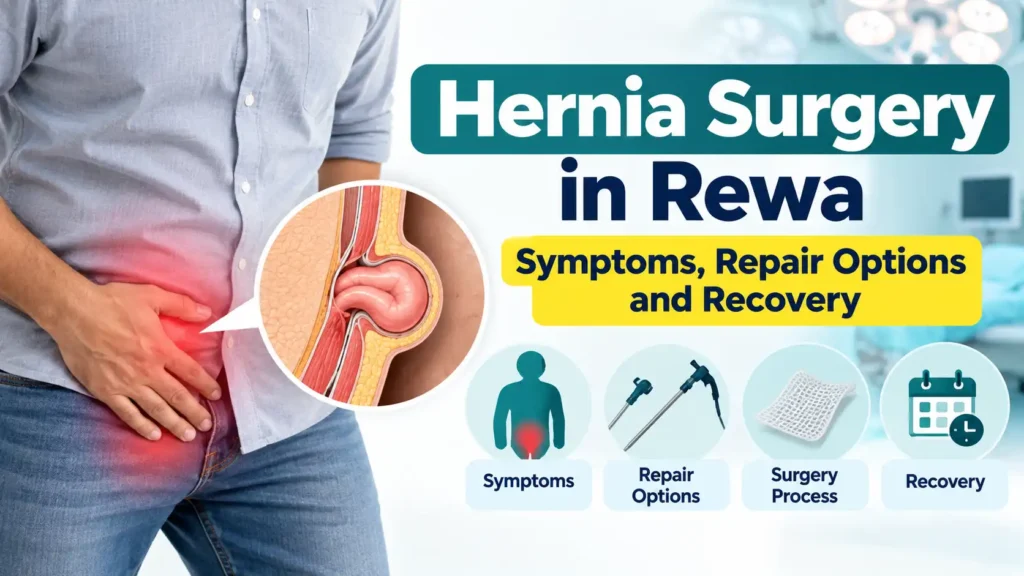
A bulge in your groin or beside your navel is easy to dismiss at first. It might only pop out when you cough, lift something heavy, or strain, and then completely slip away when you lie down. But ignoring it won’t make it disappear. That bulge is usually a hernia, a weak spot in your abdominal wall where fat or bowel is pushing through. When patients come to us for hernia surgery in Rewa, our first step is to figure out if the hernia is safely stable, or if it carries a risk of becoming trapped. While small, painless hernias can sometimes just be watched, a hernia that causes you pain or discomfort requires a permanent structural fix.
Key takeaways
- A hernia is a bulge that forms when tissue or bowel pushes through a weak area in the abdominal wall.
- Adult hernias rarely disappear on their own, yet a hernia without symptoms may be watched under a surgeon’s guidance.
- A hard, tender lump with severe pain or vomiting needs emergency care on the same day.
- Repair can be open or keyhole, often with a mesh, and the right method depends on the type, the size and your health.
- Recovery differs from person to person, and any hernia can return, so risks and alternatives deserve a clear discussion beforehand.
Hernia Symptoms and Groin Swelling: What the Bulge Feels Like
A hernia is a bulge that forms when fatty tissue or part of the bowel pushes through a weak area in the abdominal wall or groin. It often shows as a soft lump that grows when you cough, lift or strain and may flatten when you lie down. Surgery is the usual way to repair it.
- Groin swelling that appears on standing, coughing or lifting and eases on lying down.
- A bulge at or near the belly button, called an umbilical hernia, that grows with straining.
- A dragging, aching or burning feeling at the lump, often worse at the end of the day.
- A feeling of weakness or pressure in the groin when you bend or lift.
- Discomfort that returns whenever the same activity is repeated.
The Cleveland Clinic hernia guide points out that not all hernias cause symptoms, which is why some are found only during an examination.
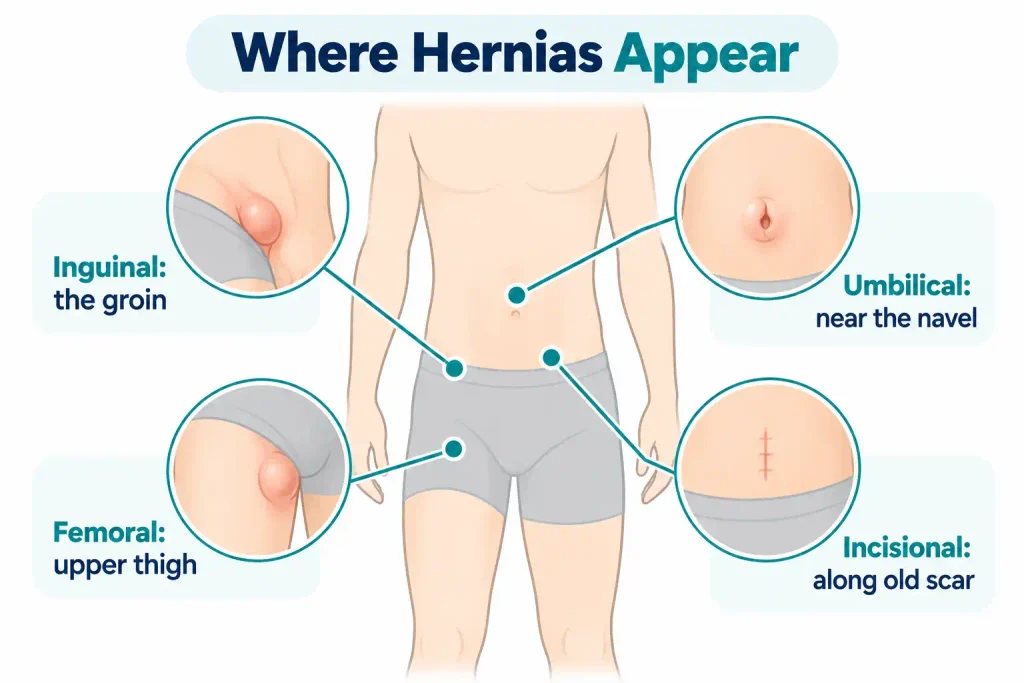
Types of Hernia and Where They Appear
Inguinal hernias are the most common groin hernias we treat at our clinic. However, our surgeons in Rewa also repair several types of abdominal wall hernias. The location of the bulge will determine both your risks and the right type of repair.
| Type of hernia | Where it appears | Who is more often affected | Points to know |
|---|---|---|---|
| Inguinal hernia | The groin, above the crease of the thigh | Men more often than women | The most common type of groin hernia |
| Femoral hernia | Just below the groin crease, on the upper thigh | Older women more often | A smaller opening, so a higher chance of becoming trapped |
| Umbilical hernia | At or near the belly button | Infants, and adults after pregnancy, weight gain or long term straining | In babies it may close with time, while adult hernias rarely do |
| Incisional hernia | Along an earlier surgical scar | Patients who have had abdominal surgery | Can be large and may need a wider repair |
| Hiatal hernia | Where the stomach pushes up through the diaphragm | Adults of any age | Causes heartburn more often than a visible lump |
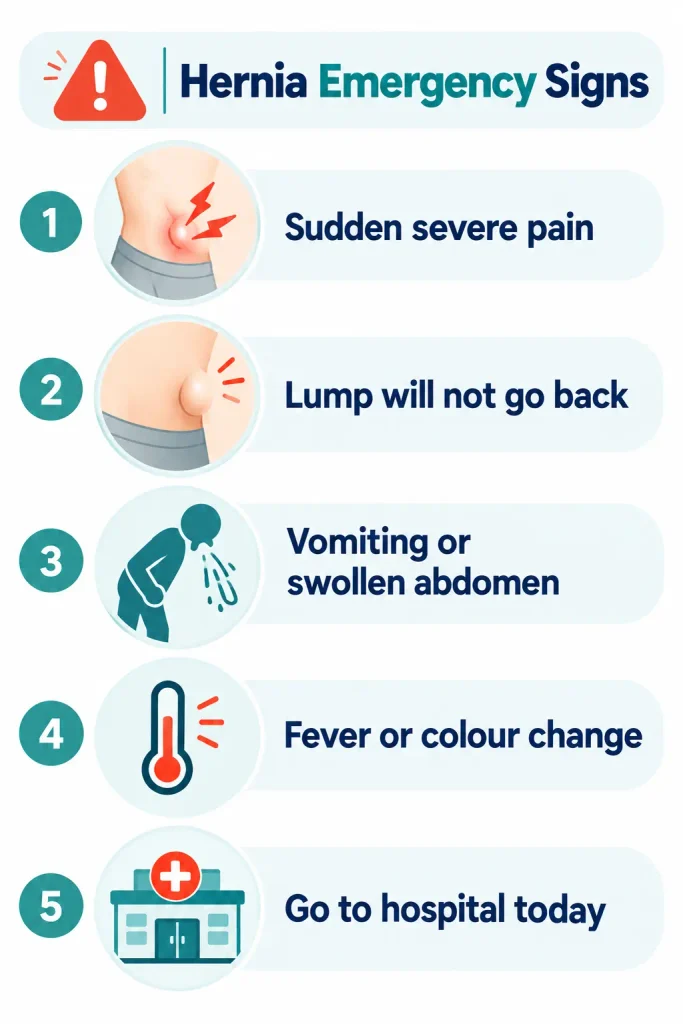
Warning Signs of a Trapped Hernia
A hernia that turns hard, tender, red or dark, cannot be pushed back, or comes with vomiting and severe pain needs emergency care at once. The bowel may be trapped or losing its blood supply.
- Sudden, severe pain at the bulge.
- A lump that will not go back, even when you lie down.
- Nausea, vomiting or a swollen, tight abdomen.
- Fever, or a lump that changes colour or feels numb.
- Not being able to pass stool or gas.
What Causes a Hernia: Weak Spots, Pressure and Daily Strain
A hernia needs two things: a weak area in the muscle wall and enough pressure inside the abdomen to push tissue through it. Some weak spots are present from birth, while others develop with age or after surgery.
- Heavy lifting at work or in the gym.
- A long lasting cough, such as in smokers or chronic chest disease.
- Straining with constipation or when passing urine.
- Being overweight, or putting on weight quickly.
- Pregnancy and childbirth.
- An earlier operation that left a weak scar.
Having these risk factors does not mean you will develop a hernia, and some hernias appear without any obvious trigger.
Hernia Diagnosis and Consultation: How a Surgeon Confirms It
A hernia consultation is usually quick and private. A hernia surgeon in Rewa can often confirm the diagnosis by examination alone, and the steps below show what to expect.
- History: when the bulge started, what brings it on, any pain, and earlier surgery or long term cough.
- Examination: the area is checked while you stand and again while you lie down, and you may be asked to cough.
- Ultrasound when needed: a scan can confirm a small or doubtful hernia, or tell a hernia apart from other lumps.
- CT scan when needed: sometimes advised for large, recurring or incisional hernias.
- Fitness assessment: blood tests, heart and chest checks and a review of your medicines before anaesthesia.
A clear hernia diagnosis matters because a lump in the groin can also be a swollen gland, a cyst or a fatty lump, and each is managed differently.
When Hernia Needs Surgery: Watching, Supports and Signs That Change the Plan
The NHS inguinal hernia repair page explains that repair is considered when a hernia causes symptoms such as pain, or to prevent bowel obstruction or a trapped blood supply, and that a hernia without symptoms may need no treatment. Surgeons usually lean towards an operation in these situations.
- Pain or discomfort that interferes with work, sleep or exercise.
- A hernia that keeps growing.
- A hernia that becomes difficult to push back.
- A femoral hernia, because of the higher chance of trapping.
- An earlier episode of trapping or obstruction.
A support belt may ease discomfort for a while, yet it does not repair the gap. Small hernias with mild symptoms can be watched, provided you know the warning signs and return promptly if they appear.
Hernia Treatment in Rewa: Repair Options Compared
| Option | What it involves | Usually considered when | Points to discuss |
|---|---|---|---|
| Watchful waiting | Regular review and advice on warning signs | A small hernia with no or mild symptoms | The hernia may grow or cause symptoms later |
| Support belt | A garment that presses on the bulge | Short term comfort while waiting or for patients unfit for surgery | Does not close the gap |
| Open repair with stitches | The weak area is closed with stitches | Selected small hernias | May have a higher chance of the hernia returning in larger gaps |
| Open mesh repair | A cut over the hernia, then a mesh placed to reinforce the wall | Groin and abdominal wall hernias in suitable patients | Wound care and mesh related risks |
| Laparoscopic repair | Keyhole cuts and a camera, with a mesh placed from inside | Hernias on both sides, recurrent hernias, or when the surgeon judges it suitable | General anaesthesia and the need for an experienced surgeon |
| Emergency repair | Urgent surgery for a trapped hernia | Obstruction or strangulation | Higher risk, and the bowel may need to be checked or repaired |
Hernia Surgery in Rewa: How Open and Keyhole Repair Works
The right method depends on where the hernia is, how big it is and your general health. Laparoscopic work at Adarsh Hospital follows the same principles as laparoscopic surgery in Rewa for other abdominal conditions, with a camera and thin instruments passing through small cuts. These hernia repair options are all carried out under anaesthesia.
Open Hernia Repair: The Steps
- You receive anaesthesia, which may be general, spinal or local with sedation.
- The surgeon makes a cut over the hernia and finds the sac.
- The contents are gently returned to the abdomen.
- The weak area is repaired, usually with a mesh that reinforces it.
- The layers are closed with stitches, glue or both.
- You are watched in the recovery area until you are ready to go to the ward or home.
Laparoscopic Hernia Repair in Rewa: The Steps
- You are given general anaesthesia.
- Gas is used to gently inflate the abdomen, and a small cut allows the camera to enter.
- Two or three more small cuts allow the instruments to be placed.
- The surgeon identifies the hernia opening and frees the sac.
- A mesh is placed over the weak area from the inside and secured.
- The gas is released and the small cuts are closed.
Laparoscopic hernia repair in Rewa or elsewhere may be changed to an open operation during surgery if the anatomy is unclear, scarring is dense or the surgeon considers it safer. This is a decision made for your protection, and your surgeon will discuss it before you consent.
Mesh Hernia Repair: What the Mesh Does and What to Ask
A mesh is a thin, flexible sheet that reinforces the weak area. Mesh hernia repair is widely used, because stitches alone can pull through weak tissue. Like any implant, a mesh carries risks, so it is reasonable to ask the following.
- Why is a mesh advised for my hernia?
- Which type of mesh will be used, and where will it sit?
- What are the alternatives for my hernia?
- What problems should I report after surgery?
Umbilical Hernia and Incisional Hernia: What Differs
An umbilical hernia in an adult is usually repaired because it rarely improves by itself, according to the Cleveland Clinic. The repair is often through a small cut beside the navel, with a mesh for all but the smallest gaps. An incisional hernia along an old scar can be large, and wider reconstruction may be needed, which a surgeon may discuss under abdominal surgery in Rewa.
Risks of Hernia Surgery to Discuss Before You Consent
A hernia operation is common and widely performed, yet all surgery carries risk. Before you make any decisions, we will sit down with you and openly discuss these potential risks:
- Bleeding, infection or a collection of fluid at the wound.
- Pain that lasts longer than expected, including long standing groin pain in a small number of patients.
- The hernia returning, which the NHS lists among possible complications.
- Difficulty passing urine after anaesthesia, mainly after groin repairs.
- Injury to nearby structures, including the bowel or the cord to the testicle.
- Mesh related problems, which are uncommon.
Ask how these risks apply to your health, what the alternatives are and what could happen if you wait. You are free to take time or seek a second opinion.
Recovery After Hernia Surgery: Pain, Lifting and Return to Routine
Recovery after hernia surgery depends on the type of hernia, the size of the repair, the method used and your general health. The NHS says recovery from an inguinal hernia repair can take up to several weeks, and sometimes longer. Your surgeon will give you a plan that fits your case.
- Take pain relief and other medicines as prescribed.
- Walk gently from the first day as advised, because movement helps recovery.
- Keep the wound clean and dry and follow the dressing advice.
- Press a pillow on the wound when you cough, sneeze or get up from bed.
- Avoid heavy lifting and hard exercise until your surgeon approves.
- Eat fibre and drink water so that you do not strain on the toilet.
- Attend the follow up visit.
Warning Signs After Hernia Surgery
- Fever or chills.
- Redness, swelling, heat or discharge at the wound.
- Heavy bleeding or a rapidly swelling groin.
- Severe pain that keeps increasing, or repeated vomiting.
- Difficulty passing urine.
Call the hospital or go to the nearest emergency department if any of these appear.
Getting Ready for Hernia Operation
- Tell your doctor about all medicines, especially blood thinners, and about diabetes and allergies.
- Bring scan reports and earlier surgery records.
- Follow the fasting instructions given for your anaesthesia.
- Stop smoking if you can, because it slows wound healing.
- Arrange for a family member to accompany you home and to help for the first days.
Habits That Reduce Strain on the Abdominal Wall
- Bend your knees when you lift, and avoid lifting beyond what your surgeon allows.
- Treat constipation early with fibre and water.
- Get a long lasting cough checked.
- Keep your weight in a healthy range.
- Seek help for difficulty passing urine instead of straining.
Booking a Hernia Consultation at Adarsh Hospital
If a bulge keeps returning, grows or causes discomfort, an examination will show whether you can watch it or need a repair. The surgical team at Adarsh Hospital provides general and laparoscopic surgery in Rewa, so related abdominal conditions can be assessed together.
- A list of your medicines and allergies.
- Any earlier scans or reports.
- A short note of when the bulge appears, what brings it on and whether it goes back by itself.
This content gives general information and does not replace an examination by a qualified doctor.
Whether your plan turns out to be watching or hernia surgery in Rewa, a clear diagnosis comes first. Book a consultation, bring your questions, and decide with your surgeon at your own pace.
Frequently Asked Questions
1. Can a hernia heal on its own?
Adult hernias rarely close by themselves. A hernia is a gap or weak spot in the muscle wall, and rest or exercise does not seal it. Umbilical hernias in babies are the main exception, because some close as the child grows. In adults a hernia may stay stable for years, grow slowly or become trapped. A support belt can ease discomfort but does not repair the gap. Have a surgeon examine any new bulge so that you know whether to watch or repair it.
2. Do all hernias need surgery?
No. The NHS says an inguinal hernia may not need treatment if it causes no symptoms. Repair is usually advised when a hernia causes pain, interferes with daily life or carries a risk of obstruction or strangulation. Small hernias with mild symptoms are sometimes watched, with clear advice on warning signs. The decision depends on the type, size and position of the hernia, your age and your general health. Your surgeon will explain whether watching or repair suits you.
3. Is hernia surgery painful?
You will receive anaesthesia, so you should not feel the operation. Afterwards, soreness, bruising and a feeling of tightness around the wound are common, and the level differs from person to person and by method. Your team will prescribe pain relief and encourage gentle walking. Pain that keeps rising, or lasts much longer than expected, needs review. Tell your surgeon early, because treatment is available for persistent pain.
4. How long does it take to recover after hernia surgery?
Recovery depends on the type of hernia, the size of the repair, the method used and your health. The NHS says recovery from an inguinal hernia repair can take up to several weeks and sometimes longer. Light activity usually restarts earlier than heavy lifting or hard exercise. Your surgeon will give you a plan and a review date for your case, so follow that advice rather than compare yourself with another patient.
5. Is mesh safe in hernia repair?
Mesh is widely used to reinforce the weak area and to lower the chance of the hernia returning, and mesh materials are regulated. Like any implant, it carries risks such as infection, discomfort and, rarely, mesh related problems that need further treatment. Some small hernias can be repaired with stitches alone. Ask your surgeon why a mesh is advised for you, which type will be used and what the alternatives are.
6. Can a hernia come back after surgery?
Yes. The NHS lists the hernia coming back among the possible complications of repair. Strain on the repair, wound infection, smoking, weight gain and weak tissue can all play a part. Your surgeon can reduce the chance by choosing a suitable method and by advising on lifting and recovery, but no method can promise that a hernia will never return. Report any new bulge early.
7. What happens if a hernia is left untreated?
Some hernias stay small and stable for years, while others grow and cause more discomfort. The main danger is that bowel becomes trapped, causing obstruction, or that its blood supply is cut off. This is an emergency with severe pain, a hard lump and vomiting. If your hernia is watched rather than repaired, learn the warning signs and return at once if any appear.
8. How do I know whether keyhole or open repair suits me?
The NHS says the type of surgery depends on where the hernia is, how big it is and your general health. Keyhole repair is often considered for hernias on both sides or those that have returned, while open repair may suit some emergency cases or patients who cannot have a general anaesthetic. The surgeon’s experience also matters. Ask your surgeon why a method is advised and what the alternatives are.
9. Which doctor should I see for a hernia in Rewa?
A general surgeon is the usual specialist for hernias. A hernia surgeon in Rewa will take your history, examine you, arrange an ultrasound if needed and explain whether you can watch the hernia or need hernia surgery in Rewa. Bring a list of your medicines and any earlier reports. A family physician can start the assessment and refer you if surgery looks likely.
10. How much does hernia surgery cost?
The cost of hernia surgery in Rewa depends on the type of hernia, the method, the anaesthesia, the room category, the tests, the length of stay and the medicines. A reliable figure cannot be given without an examination. After your consultation, ask the hospital billing desk for a written estimate that lists what is included, so you can plan ahead and ask questions before you decide.